

The Leader's Floor Lookout: Week of September 14, 2026
Here's what to watch for on the House Floor this week:
In 2023, the Biden Administration issued a rule allowing California to enforce a radical climate tax targeting shipping vessels. The regulation forces certain cargo ships to turn off their diesel engines while at California ports or face steep penalties.
This costly mandate is hurting America’s supply chains and driving up prices. Ships could face tens of thousands of dollars in penalties each day if they fail to abide by this rule. Those costs are ultimately passed on to consumers. With two of America’s largest ports in California and the state processing roughly 40% of containers entering the United States, this rule raises prices not just for Californians, but for families across the country.
House Republicans are advancing legislation to overturn this burdensome policy, lower costs for American families, and strengthen our supply chains.
Rep. Vince Fong’s joint resolution, H.J.Res. 210, overturns an Environmental Protection Agency rule granting a Clean Air Act waiver which limits pollution from ocean-going vessels docked at port.
House Republicans are taking action to rollback another costly Biden-era regulation to lower costs for American families and strengthen supply chains.
Rolling Back Burdensome Climate Regulations
California’s maritime industry is a major part of the state’s economy, helping move goods throughout the state and across the country while supporting nearly three million American jobs.
In 2025, the Biden Administration authorized California to enforce its onerous Commercial Harbor Craft Amendments, which expanded existing emissions regulations on commercial vessels and imposed new engine standards, including zero-emissions requirements for several vessel categories.
Vessel owners and operators face significant costs to comply with these new standards. Those costs could put additional pressure on maritime businesses and affect the competitiveness of California’s ports. This week, House Republicans are bringing legislation to the floor to rescind California’s harmful harbor craft mandate.
Rep. James Gallagher’s joint resolution, H.J.Res. 213, disapproves of the Environmental Protection Agency’s rule regarding California’s harbor craft regulations and nonroad engine pollution control standards.
House Republicans are combating radical climate policies that drive up costs, hurt the maritime industry, and weaken our supply chains.
Strengthening Federal Oversight of Taxpayer-Funded Programs
Many major federal programs, including Medicaid, SNAP, disaster assistance and small business programs, are federally funded but administered by state or local governments, leaving them vulnerable to fraud. As we saw in Minnesota, when state officials fail to provide adequate oversight or even worse - turn a blind eye to abuse, fraudsters can steal taxpayer dollars and go undetected.
That’s why Vice President JD Vance called on Congress to pass legislation requiring states to share information with the Department of Justice about how programs are administered and who receives these benefits. This will allow the federal government to better protect taxpayer dollars and prosecute fraudsters.
This week, House Republicans are answering Vice President Vance’s call by bringing legislation to the floor to improve information sharing between states and the federal government, helping identify fraud faster, protect taxpayer dollars and hold criminals accountable.
Rep. Van Drew’s bill, H.R. 10326, Preventing Rip-offs and Obtaining Oversight of Funds Act would strengthen federal oversight by enhancing information-sharing capabilities between state administrators and federal law enforcement, making it easier to investigate fraud in federally-funded programs.
House Republicans are continuing to safeguard taxpayer dollars and crack down on fraud.
Cracking Down on Fraud and Protecting Taxpayer Dollars
According to the Government Accountability Office, the federal government loses an estimated $233 billion to $521 billion every year to fraud. It’s clear this is a government-wide problem that requires a government-wide response.
Prior to the Trump Administration, there was no fraud-focused team responsible for combating fraud across the federal government and holding fraudsters accountable. In January, President Trump established the Division for National Fraud Enforcement within the Department of Justice. The new office works with departments and agencies to crack down on fraud schemes across jurisdictions.
In recent months, Americans have seen for themselves how rampant fraud has become and why the federal government needs one office leading the charge to safeguard taxpayer dollars, protect federal programs for those who need them, and pursue criminals stealing from them.
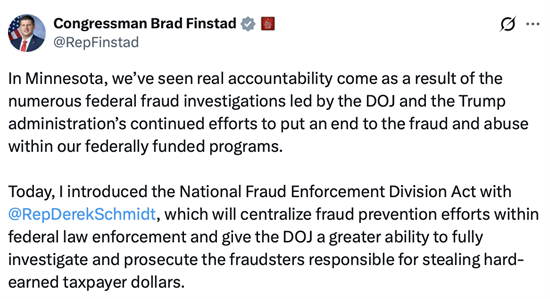
This week, the House will consider legislation that codifies the Trump Administration's creation of the National Fraud Enforcement Division at the Department of Justice and the role of Assistant Attorney General to lead the division.
Rep. Brad Finstad’s bill, H.R. 9576, the National Fraud Enforcement Division Act, establishes a National Fraud Enforcement Division within the Department of Justice, led by an Assistant Attorney General appointed by the President and confirmed by the Senate.
House Republicans are committed to fighting fraud and hold those who steal taxpayer dollars accountable.
|
Holding Russia and Iran Accountable
America must continue to stand strong against hostile foreign regimes that threaten our national security and global stability. Russia and Iran have repeatedly worked to undermine American interests and destabilize our allies around the world.
The United States must use every available tool to hold these regimes accountable. That is why this week, the House will consider amended legislation to strengthen sanctions against the Russian government, financial institutions, and those supporting Russia’s military in its unjust war on Ukraine. The legislation would also increase pressure on countries that purchase Russian oil and gas or help Russia evade sanctions, while restricting new U.S. investment in Russia.
The Senate amendments to H.R. 5334 includes the Lindsey O. Graham Sanctioning Russia and Iran Act of 2026 which presents new sanctions against Russia and extends the Iran Sanctions Act through 2031.
House Republicans are taking action to strengthen American national security, hold hostile regimes accountable, and ensure that those who threaten the United States and our allies face serious consequences.
###
Legal Disclaimer:
EIN Presswire provides this news content "as is" without warranty of any kind. We do not accept any responsibility or liability for the accuracy, content, images, videos, licenses, completeness, legality, or reliability of the information contained in this article. If you have any complaints or copyright issues related to this article, kindly contact the author above.
